
Consultants can work in a wide range of industries, and are typically employed in sectors such as management, finance, healthcare, information technology, human resources, marketing, and operations. Consulting firms, which vary in size from large multinational companies to small boutique firms, are the most common employers of consultants. These firms often provide services like business strategy development, process optimization, risk management, or technology implementation. Consultants can also be hired in-house by large companies to provide long-term advice and strategies, as this centralizes their internal processes. Consultants are also found in government agencies, non-profits, academic institutions, and/or freelancing. The flexibility of the consulting profession allows individuals to work across various fields and industries, enabling them to apply their expertise in diverse contexts.
Common Consulting Resources
- Case in Point, Marc Cosentino
- Crack the Case, David Ohrval
- Case Interview Secrets, Victor Cheng
- Interview Math, Lewis C. Lin
- Various MBA case books such as Esade, Fuqua, Darden, etc.
Reading and learning about different case interview structures and approaches is helpful, but nothing beats pure and simple live practice.
Consulting Resources for WashU Students
- Management Consulted: the world’s largest community on management consulting and resource to learn how to ace the case interview and build management consulting skills. The MC site includes comprehensive case interview content, drills, and a case interview bank.
- Wall Street Oasis: Access Wall Street Oasis’ Master Consulting Case Interviews guide which includes an overview of the firms, case interview training, and a bank of sample cases.
- MConsulting Prep: additional case interview samples from top consulting firms and case books from leading MBA programs.
- Career websites for the Consulting Firms: don’t forget to tap into the rich resources the consulting firms, themselves, offer. The firms commonly offer you tips and tricks for preparing for their interview process and may give you deeper insights into their practice areas. It would be a mistake to gloss over!
Case Interview Articles
- No Case Interview Experience? Start Here by Management Consulted
- Case Interview Frameworks: Ultimate Guide by Management Consulted
- 6 Types of Case Interviews | Case Interview Prep Resources by Management Consulted
Overview of Consulting:
- Consulting 101 by Management Consulted
- Consulting Skills by Management Consulted
- Networking for Consulting by Management Consulted
- Success on the Job: Mastering Your First Three Months by Management Consulted
Case Interviews:
- Case Interviews by Management Consulted
- Case Interview Fundamentals by MConsulting Prep
- Case Study Samples by Management Consulted
Consulting F.A.Q.
- Experience a multitude of different industries through fast-paced projects, using problem-solving skills to deliver data-driven solutions
- Challenge and variety are a must – learn a variety of different skills and competencies to continuously grow and meet the needs of clients
- Collaborate with your case team and firm partners to solve complex, multi-faceted problems
- Make a long-lasting, powerful impact while supporting your clients and building relationships across the world
- Partner with C-Suite-level individuals early on in your career
- Consulting:
- Utilize qualitative and quantitative analyses skills and research competencies to support a multitude of different functions – ranging from supporting business operations (operations, profitability, management, etc.), to global issues (energy, sustainability, etc.).
- In consulting, you’ll have the opportunity to interface with a wide variety of clients across a multitude of different industries in order to deliver powerful recommendations for their concerns, while continuously receiving professional development and learning opportunities
- Investment Banking:
- Perform detailed financial analysis and create models to evaluate companies, assess investment opportunities, and support decisions on capital raising and structure, mergers and acquisitions, and other financial transactions.
- In IB, you work in a client advisory capacity, delivering capital structure and investment recommendations and providing access to capital markets that meet clients’ financing needs.
While there is no one set way to become a consultant, there are a few ways that candidates can stand out:
- Start Casing Early: This is probably one of the most salient things (which we will get into later); you want to continuously improve your casing skill as it is key to thriving as a consultant.
- Networking: Many of our partner firms have in-person or virtual events that can be found through Handshake. If you are looking to expand your network beyond what you can find just on LinkedIn, try WashU CNX, a WashU-specific networking platform.
- Get Involved: Outside of forging connections with alumni and/or employers, you can get involved on campus through a variety of the student-ran consulting clubs.
- Early Programming: There are a variety of opportunities for students to get involved in consulting early through a multitude of firm-related sophomore programming, including leadership rotations, diversity recruitment, and other related initiatives.
Consulting Industry Overview
Opportunities for Students
There are plenty of people you can case with – it is recommended to run around 3-5 cases a week:
- Business Career Coaches
- Business Peer Coaches (not available over Summer)
- Consulting-Based Organizations
- Fellow Students
- Alumni
- Arch Consulting: Arch Consulting is a competitive group that provides a formal structure of training students for case competitions hosted by top business schools across the country and also consults for businesses nationally and internationally.
- Center for Experiential Learning (CEL): CEL offers several programs geared to give students the opportunity to develop core consulting competencies including project management, critical thinking, problem-solving, leadership, and communication skills. These programs are for-credit classes. Discuss the feasibility of enrolling in one of them with your academic advisor.
- Consult Your Community (CYC): CYC offers students a chance to engage in semester-long consulting projects for clients including local startups, small businesses, and student-run businesses.
- Bear Studios: a for-profit enterprise that leverages undergraduate talent to provide high-quality services to real-world clients of all shapes and sizes. Bear Studios offers opportunities in three distinct service lines including strategy, design, and technology.
- Design for America WashU: an award-winning nationwide network of interdisciplinary student teams and community members using design to create local and social impact.
- TAMID exists to develop the professional skills of undergraduate students through hands-on interactions with the Israeli economy including student consulting teams.
- Global Research and Consulting Group Global Research and Consulting Group is a 501(c)3 nonprofit that operates worldwide from leading universities with the mission of helping global non-profits, social impact startups, and governmental organizations achieve their goals while simultaneously empowering students to give back to the global community.
- 180 Degrees Consulting WashU: WashU Chapter of the National 180 Degrees Consulting organization, serving St. Louis by providing consulting services to non-profit organizations and companies focusing on social impact.
There are two places where the Business Career Community shares consulting events:
- Microsoft Teams: Check out the Consulting channel – we highlight our events there!
- Handshake: Check out firm events, and the “Consulting Series” events!
Industry Information
Consultants can be part of nearly any industry; while many do have relations to global corporations, there are also consultants that serve other industries such as higher education, healthcare, and many more. The flexibility of the consulting profession allows individuals to work across various fields and industries, enabling them to apply their expertise in diverse contexts.
Consultants, outside of working within a multitude of different industries and focuses, will also have a small variation within their positioning. This positioning will impact a consultant’s career in a multitude of ways, as both styles can lead to a multitude of different growth opportunities, exit opportunities, learning opportunities, and styles of working. Keep in mind that, while different, both are equally important and have different benefits and drawbacks.
- Internal: Typically, internal consultants are hired by one singular organization (or organizational chain) to handle any internal considerations that may occur, which allows for more intentional support and familiarity with organizational needs.
- Clients Served: The singular company the internal consultant works for, can range from C-Suite to specific departments.
- How They Serve: Internal consultants not only support organizations through recommendations, but also facilitate the change management processes and project management along the way.
- Where It Differs: Due to the close proximity the internal consultants will have with the issue at-hand, they will be with a project from start-to-finish, and will be able to make in-the-moment changes to the planning to ensure that all related processes function appropriately.
- External: The more standard type of consulting, external consultants are typically hired by specific consulting firms rather than individual companies to support the needs of any client companies that request their support.
- Clients Served: There are a multitude of organizations across a multitude of industries that can be supported.
- How They Serve: External consultants work to provide recommendations for clients that directly serve their needs through extensive data-informed decision-making and industry research.
- Where It Differs: Since they are contracted by various clients across the country (and sometimes the globe), many external consultants will be traveling frequently and will only provide recommendations, before moving on to the next case.
- Management/Strategy Consulting: Collaborating with senior leadership to fine-tune processes and develop strategic initiatives. The services provided under this area range from profitability analyses to M&A strategies, and recommendations will be geared towards developing and implementing appropriate strategies to solve the concerns. This is one of the more “common” consulting types, and is the one you will hear the most about.
- Operations Consulting: While similar to management consulting at a fundamental level, operations consulting is all about promoting efficiency, be it through reducing costs/capital or approaching root cause issues. Operations consultants typically directly support the implementation of initiatives.
- Financial Consulting: Focusing more on the structural side of financial decisions, these consultants tend to support organizations in understanding the complexities of finance, and how it relates to processes. Contrary to popular belief, they do not work purely with the financial numbers, but rather with the surrounding variables that may also impact or be impacted by the financial decision-making.
- Human Resource/Capital Consulting: Despite the name, this is related to managing the people of an organization, not the department of the same name! HR consultants tend to focus on recommendations centralizing employee development, retention, and usefulness to the organization.
- Risk/Compliance Consulting: This branch of consulting is more straight-forward – it involves ensuring that organizations are not only reducing any form of hazard, but also dually ensuring that all organizations are up-to-code when it comes to regulatory needs for a specific industry.
- IT/Tech Consulting: With the advent of technology becoming more integrated into all aspects of life, the workplace included, these consultants work with firms to ensure how to best integrate technology into their processes in a safe, secure manner, while also promoting technological efficiency in application and security.
- Healthcare Consulting: Healthcare has been on the rise, especially given the leaps and bounds in both medical technology, and evolving patient care. Healthcare consultants are brought in to ensure that an entity is operating as efficiently as possible, as well as streamlining relevant processes and procedures.
- Education Consulting: These consultants can be brought in to work with the school district or campus to facilitate a wide range of services, from enriching the student experience to promoting reform to financial aid. This section is unique in that it may allow you to not only work with educational leadership, but also with the community at large.
- Environmental, Sustainability, and Governance (ESG) Consulting: Given the importance of ESG, particularly with new research being brought to light, many organizations are becoming more conscientious of their environmental footprint. These consultants provide best-practice recommendations on how to reduce an organization’s impact, alongside action that can be taken to move towards sustainability.
- Government Consulting: Whether it be working for local or federal government, these consultants work on providing recommendations on how to best manage government offices and associated entities, as well as providing insights on best practices for policy development and implementation.
- AI Consulting: A relatively new branch of consulting, AI consultants educate companies on how to best utilize AI within their organizations, while also ensuring that AI is not used as a “crutch”.
Preparing for Consulting Recruiting – Applications and Common Considerations
This is a more specified breakdown of what is found on our Recruiting Timelines page. Keep in mind that all ranges are open to change at the discretion of an industry’s firms. More specifics can be found on Management Consulted’s Consulting Firm Deadlines page.
Consulting’s recruitment cycle typically begins in late Spring, and lasts until late Fall, and typically recruits a year in advance. Outside of full-time recruiting, internships are typically reserved for juniors, but there are some internships and more commonly, leadership and early recruitment programs, geared towards sophomores. It is recommended that you begin casing three to six months before you apply, and networking should be started as soon as possible when you decide on recruiting for consulting.
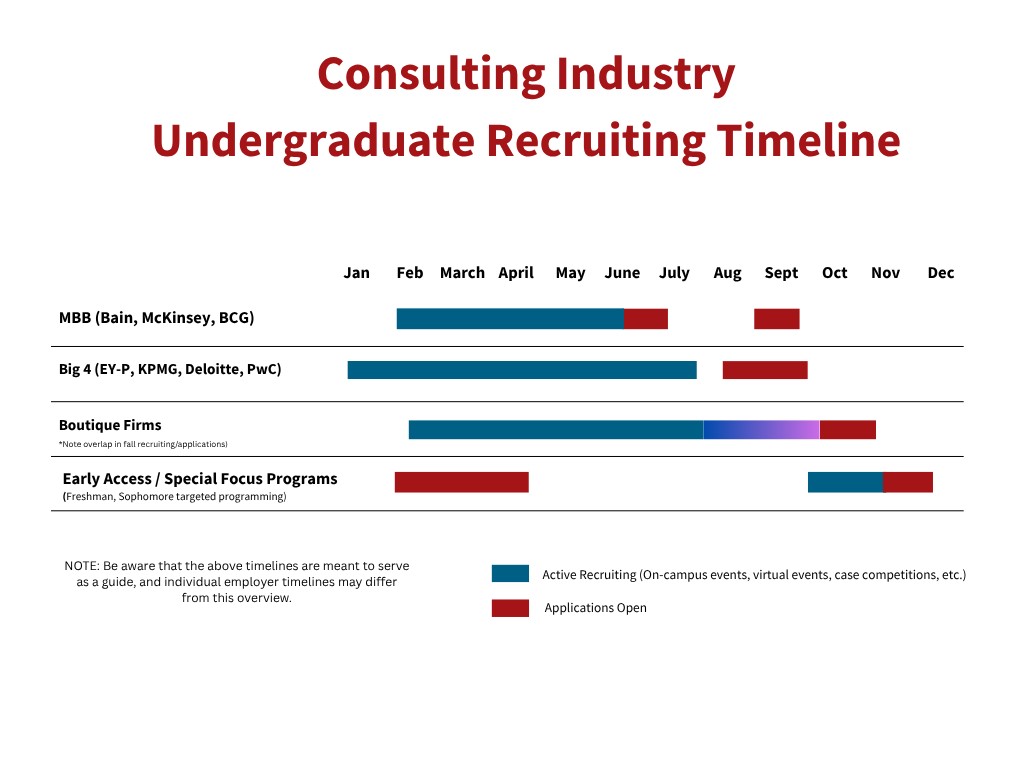
Common deadlines to be aware of:
- McKinsey & Co., Bain & Co., Boston Consulting Group (MBB): Mid-Summer, and Late Summer
- Early Access & Specialty Programs: Early Fall of Sophomore Year
- Big Four (Deloitte, PwC, EY, KPMG): Late Summer to Early Fall
- Boutique Firms: Late Spring to Late Fall (Most are Late Summer to Late Fall)
- Specialty/Small Firms: Varies
Consulting cover letters, beyond being a pipeline from your resume to the role, are where you can showcase how your experiences have prepared you to be a consultant. While many roles in consulting do not follow a standard job posting (e.g., wealth of bullet points to tailor with), you want to ensure that you understand three things:
- The Firm You Are Applying To: Typically gained through extensive research and/or networking, you want to speak to what specifically that firm is doing that captures your interest – think beyond surface-level considerations (e.g., ERGs, “commitment to clients”, etc.) and speak more towards the actions of the firm that make it distinct (e.g., publicly available records, contributions to ESG/public good, etc.) and why it matches your values.
- How Your Skills Match: Even if you do not have consulting experience, you may have a wealth of consulting related skills that you can showcase. Ensure that you highlight your skills themselves and showcase how you have utilized them.
- Why Your Skills are Relevant: Outside of speaking on your skills, show how they are relevant to the firm. What can you use your skills for to best support the firm and their clients?
For more information, check out the Business Career Community’s cover letter page!
Preparing for Consulting Recruiting – Behavioral Interviews
These questions are meant to assess interest and cultural fit. Common examples include:
- Can you tell me about yourself? or Can you walk me through your resume?
- Why are you interested in consulting?
- Why are you interested in this firm/location?
- Can you give me X strengths and weaknesses?
These questions are meant to test skills and competencies. They should typically be answered in STAR format. Common areas asked about include:
- Adaptability
- Collaboration
- Conflict Resolution
- Critical Thinking
- Customer Service
- Project Overview
- Leadership
- Organization
- Resilience
- Results Driving
- Time Management
Outside of standard interviews and the case interview (covered below), consulting interviews may also include several atypical formats:
- Chatbot Interviews
- Games
- Assessments
There are many more, and how these are presented are changed at the firms’ discretion. For other common examples, check out our Interview Page!
Consulting Recruiting – Case Interviews
Your case will begin with what the client is requesting us for. There will be some background information, surrounding context, and the business question. It is important to take notes on 3 things:
- Nouns: Proper names for companies and products, etc.
- Numbers: Not common in prompts – typically important.
- Nuance: What the client is focused on; how the background information can be used to drive the case.
Once you have heard the prompt, you will repeat what you heard back
Once you have an understanding of the business question, you want to ensure that you can dig a bit deeper to learn more about the direction of the case, and any supplemental information to help determine constraints.
Common clarifying questions involve:
- Goal/Benchmarking: Typically not given in the prompt, it is important to understand what the client defines as success.
- Comparison: Beyond X v. Y company, comparison can look at differences between any variables, even internally to the company or externally within the market.
- Scope: What is the company doing, where are they working in, how do they interact with the population in general, etc.
More often than not, you will ask specific questions based on the prompt – it is important to ask questions that are both related to the direct business question, yet not so specific that you rule out information – be objective if possible.
Once you have asked your clarifying questions, you can move on to the grand pause – a request for time (typically 2 minutes) to create your framework.
When creating your framework, you should standardly aim for 3-4 categories, with at least 3 talking points under each, while also considering:
- MECE (Mutually Exclusive, Collectively Exhaustive): Ensure that your categories do not overlap, that there are no dependencies between categories, and that all categories can make the whole consideration of the business question.
- Relevance: All categories (and everything in the case itself) should be related to the client’s business question. Remain objective and consider all possibilities.
- Realism: Ensure that your category is something that could be realistically considered given available constraints and information – avoid “pushing back” on the client (e.g., client wants to look at market entry, candidate pushes towards pure profitability framework and avoids market considerations).
Once you are ready to present, be prepared to go through your framework by presenting categories first, and then deep diving into each. Aim for 2-3 minutes on presentation, and end by choosing an area you want to learn more about.
Once you decide a direction, you will either be pushed towards the direction depending on your answer (candidate-led), or given a direct question that the “client” wants to consider (interviewer-led). This is the next step of the case, and often will require qualitative and quantitative reasoning to move forward.
Common analytic portions include:
- Exhibits: Graphs, charts, and other collections of information that provide an “additional layer” to the case – often presenting some level of quantitative information.
- Case Math: Typically correlating with exhibits, but can stand alone, are calculations that need to be done to help answer the client’s business question. For more information, see Management Consulted’s common calculations list.
- Brainstorming: Free thought based on a given prompt – use common sense and creativity to determine a multitude of directions the prompt can lead to.
The end of the case, this is where you summarize your findings from your work to answer the business question.
Standard Format (RRRN):
- Recommendation: Tell the client what you think they should do – be direct and decisive.
- Rationale: Summarize your findings from the case – why your recommendation?
- Risk & Mitigation: What should the client be aware of when implementing your strategy, and how can they work around it?
- Next Steps: What should the client do first to implement your strategy?
Keep in mind that each firm may have a different style of case interview, ranging from various games and assessments to a modification of the original case interview structure (e.g., no framework, no pausing for X portion, etc.) – it is recommended to familiarize yourself with casing in general rather than practice those specific styles.
Tips for Understanding the Case Interview
How you take notes can be the difference between an organized case interview experience, and grasping at straws.
Typically, you should take notes throughout the case, as all of your work will be relevant for your recommendation. Practice taking shorthand notes while listening to something, and see how well you recall the information.
It is recommended to use one side of a paper for notes, as flipping a page can be both distracting and show disorganization.
When developing a framework, there are different considerations that can go into development. You may pull from commonly existing frameworks (e.g., Porter’s 5 Forces, etc.) or develop a custom approach depending on the business question.
Present your framework from the most internal to the most external, and organize your buckets to ensure MECE-compliance.
Case math should be “chunked” when possible to make things easier:
(e.g., 2.2% of 500: 500 x 0.01 = 5 x 2 = 10, 5 x 0.2% = 1, 10 + 1 = 11)
Familiarize yourself with common calculations, and ensure that you understand different math-related concepts depending on the industry you are consulting with (e.g., credit with finance firms, EBITDA with M&A firms, etc.)
When presenting throughout your case, remember Consulting Industry Career Coach Lenore Albee’s 3 Cs:
- Clear
- Concise
- Confident
Brainstorming should both be related to the business question of the case, but should also have some level of creativity involved. Consider two “common sense” categories, and two “creative approach” categories. Some things to consider:
- Strategically Sound: Are these things your client could consider both realistically and ethically?
- Real Life Relevance: Based on your own experiences with similar industries, are there any things you could recommend?
- Thinking Outside the Box: Are there atypical approaches that may yield unexpected results?
Market sizing is a creative way to determine the “capture rate” of a particular product or company within an industry, which could then be used to inform profitability.
Most market sizing relies on segmentation based on various criteria (e.g., age is most common, rate of use typically follows, etc.) but it is important to use deductive reasoning to ensure you are meeting your client’s needs.
For more info, see the video below: