
Career Coaching
Career Coaches are members of the Center for Career Engagement team. We work collaboratively with you – students and alumni – to create and tailor resumes/cover letters, prepare for and practice interviewing skills, develop and execute search strategies for clinical and research opportunities, manage and evaluate offers, and explore other career fields if your interests change.
Prehealth Advising
Prehealth Advisors support students and alumni as they plan for and apply to post-graduate professional programs like medicine (MD and DO), PA school, nursing, physical therapy, veterinary school, optometry, audiology, etc…They can assist you with your academic plans, help you determine whether you’ve completed all necessary prerequisites. They can also help you assess whether you have acquired a competitive portfolio, both academic and extracurricular, for attaining your specific post-WashU educational goals.
Some key prehealth advising resources:
- Prehealth website – https://prehealth.wustl.edu/
- Prehealth Advising Team & Drop-In Hours – https://prehealth.wustl.edu/advising
- Join the Health Care & Sciences Team Channel to get real-time info on job + internship openings, career events, and quick updates
- MyPreHealth portal for storing recommendation letters and documents. Create an account at https://prehealth.wustl.edu/MyPreHealth
Are you interested in exploring healthcare professions? Two great online resources are available to you:
The Occupational Outlook Handbook is the government’s premier source for career guidance featuring hundreds of occupations. Enter a job title in the search field, such as physician assistant. You’ll find information pertaining to duties, median pay, how to become one, work environment, similar occupations and job outlook.
The Health Field Options page on the WashU prehealth website lists a variety of clinical pathways. Click on the names of the professions you would like to explore to learn about the application process for grad/professional school and other useful resources.
Application & Interview Timeline
- April/May: Prepare for Casper Assessment or AAMC PREviewProfessional Readiness Exam (if required by any of your targeted schools)
- June: Submit primary application through AMCAS. Early submission considered early June, latest is July.
- July/August: complete secondary applications within two weeks of receiving
- Late August/early September: interview invitations starting to be sent; accept the earliest interview dates sent
- September – February: bulk of interview season, some may be offered in March
What’s Being Assessed
- AAMC Core Competencies for Entering Med School
- Motivation
- Familiarity with the field
- Knowledge of and fit with the school
Types of Interviews
- Traditional
- Multiple Mini Interview (MMI)
Traditional Interview Types
- Open – interviewer has access to entire application
- Blind – interviewer has seen no part of your file/application
- Partial Blind – interviewer knows only your GPA and MCAT scores, or perhaps has seen only your personal statement and secondary essays
- Stress – interviewer tries to make you feel a bit uncomfortable, perhaps challenging some of your activities, motivation, etc., to see how you react to ‘stress’
- Group – interview with a group of applicants
- Panel – more than one interviewer
Traditional Interview Format
- Usually open file
- One or more one-on-one interviews
- Typically 30 – 60 minutes
- Interviewers are MDs, PhDs, medical students
Traditional Interview Questions
- General questions about candidate: tell me about yourself; strengths/weaknesses
- Application specific: activities list – why did you choose?; your research
- Transcript – Cs, Ds, Ws, semesters with low GPA, institutional actions
- Why should we admit you?
- What will you do if not accepted this cycle?
- Behavioral (tell me about a time when X happened)
- Ethical
- Policy
- Fit and match for school
- Future career goal
Examples of Questions to Ask Interviewers
- What kind of mentoring do you provide?
- What are some things current students say they like the most about your school?
- What are some of the things that students say they wish were different?
- Is there anything new in the program or curriculum on the horizon?
Post-Interview
- Write a follow-up thank you note to interviewers
- Reflect on the experience and strategize for next interview
Multiple Mini Interview (MMI)
- An interview format that consists of a series of 6-10 virtual or in-person interview stations, each focused on a different question or scenario
- Designed to measure competencies like oral communication, interpersonal, nonverbal, critical thinking, teamwork skills, professionalism and ethical decision-making skills
MMI Rationale
- Better at assessing applicant’s soft, non-cognitive skills
- Reduces interviewer bias
- Less labor-intensive – evaluators may be physicians, admissions staff, other staff, community members, medical students, actors, etc.
- Better “test reliability” than other formats
- Better predictive correlation for future success in medical school and career
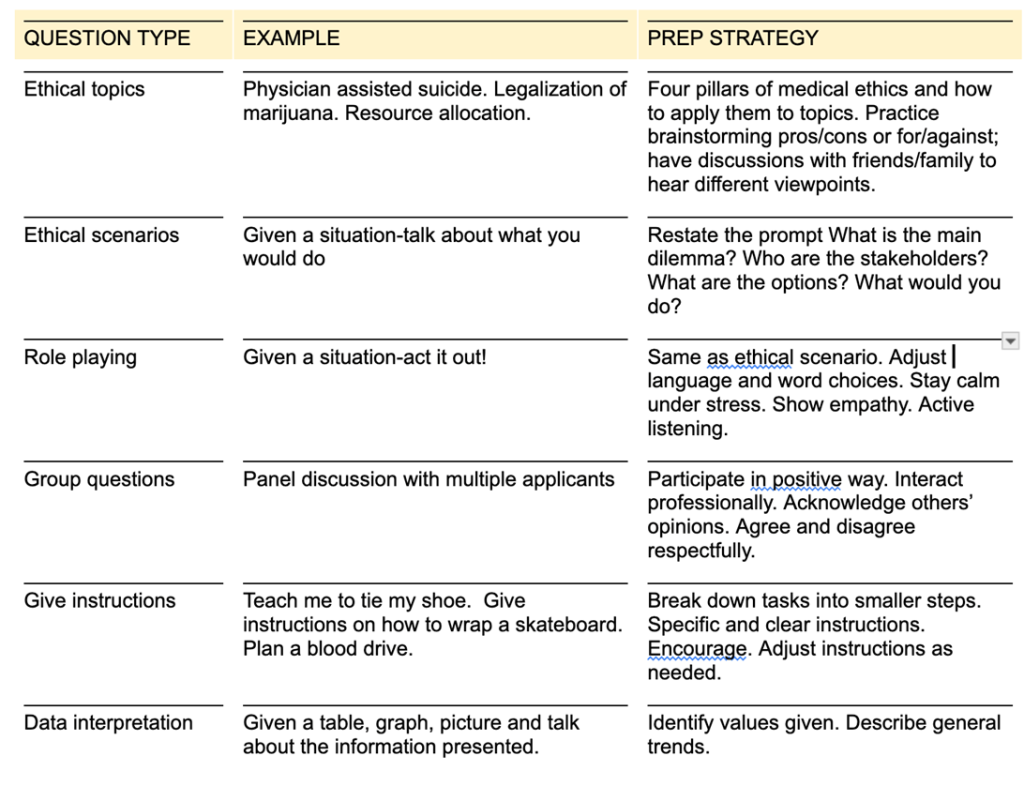
Types of Questions/Prompts/Scenarios
- Ethical topics or ethical scenarios
- Standard traditional interview questions (not as common)
- Interactions with an actor (role play)
- Write about a topic
- Communication (give directions)
- Group collaboration (completion of a task)
- Data interpretation
What to Expect at Stations
- At some stations, you may speak solo for the entire time
- Sometimes after you finish speaking, you may be asked 2-3 follow-up questions
- One station may have a “traditional question”
- Some stations will have a medical focus, but some may not
- Many stations may have an ethical focus
- You may be required to interact with actor or do a team activity with someone else in the room
How to Prepare for Medical School Interviews
- Schedule a mock traditional or MMI interview with a career coach
- Students and alumni are limited to a max of three mock interviews from August 15th – October 31st
- Practice your interviewing skills via Big Interview
- You may use the set of practice questions we created or choose from a variety of other questions
- Go to the Big Interview website
- You should be able to login by clicking in the upper right corner ‘Login via Washington University in St. Louis’ (this should be single sign-on)
- On the next screen click the ‘Interviews’ drop-down arrow in the upper left- hand corner
- Choose ‘Interview Assignments’
- Enter code in the Blue Box that says: ‘Assignment Code’ and click ‘Go’. There are two types of interview sets: Medical School Mock Interview (Code 715789) and Pre-Health Mock Interview (Code 6ab94e)
- Follow the instructions and do the interview! Then you’ll be given a score (Bronze, Silver or Gold) and feedback from the AI feature.
- Watch a video presentation by a Career Coach on tips for answering common questions here
- Watch a video presentation by a Career Coach on tips for preparing for medical school interviews here
- Watch a panel discussion “Medical School Interview Tips: Advice from Med Students” here
- Watch a video presentation by a Career Coach “The MMI Playbook-Strategies for MMI Stations” here
- Read Interview Resources for Medical School Applicants
- Familiarize yourself with the STAR method for answering behavioral questions
- Familiarize yourself with current issues in healthcare.
- Learn the Four Pillars of Medical Ethics
- Read and reflect on the Premed Competencies for Entering Medical Students
You may be applying for a summer program, internship, dental school or perhaps your first job. Whatever the opportunity, preparation is crucial and there are several things you can do to set yourself up for success and increase your chances for an offer.
- Research, research, research – know the organization’s mission and values and be able to speak to how they align with yours.
- Practice – with friends, family members, a Career Coach. Don’t write a script but have in your mind the points that you want to make. You don’t want to sound too rehearsed.
- Be authentic. Don’t give answers you think they want to hear, be true to yourself. Think about your ‘brand’, what makes you unique – weave those qualities, skills and experiences in throughout your responses.
- Share examples, provide anecdotes when possible. Telling stories creates a longer-lasting impression than describing something.
- Show enthusiasm and passion. Being excited about the organization, the position, and how well what you bring aligns with what they’re looking for goes a long way.
- If you get a challenging question, say “Great question, may I have a moment to think?”. Gather your thoughts, then respond.
- Prepare questions for each interviewer in the room. Don’t ask anything you can find out on your own.
- Remember, an interview is as much about you determining if the opportunity is right for you, as much as they’re evaluating whether you’re the right fit for them.
- Dress professionally, be confident yet humble, smile a lot, have a firm handshake (if in person), and most importantly, have fun!
Some common questions to consider:
- Tell me about yourself
- Why this field (medicine, dentistry, research, etc…)?
- In choosing this field (i.e. PT), did you consider others (i.e. medicine)? If so, why did you choose this as your future career?
- What unique aspects of your path to this field make you a strong candidate?
- What are your strengths and areas for growth?
- Why do you think you’ll be a good candidate for our program?
- What will you contribute to our program?
- If there are any requirements you have yet to complete for this position/program, what is your plan for fulfilling them?
- Tell me about your research.
- Talk a little about your volunteer experience at X organization.
- Tell me about a time when you…
- Failed and what you learned from it
- Received criticism and how you handled it
- Took initiative
- What is the most pressing issue facing our field today?
For more information on interview prep, see our Resources page.
Big Interview is a great interview prep resource that allows you to:
- Practice on your own
- Record your answers to practice interview questions and review them on your own
- Evaluate your eye contact, body language and word choice via an AI feature
- Make up your own practice interview by choosing the questions you want to practice; enables you to practice those questions as many times as you’d like.
The Health Care and Sciences Career Coaching Team has prepared two pre-health practice Interview Assignments for our students and alumni looking for more practice before they head into interviews. The Medical School Mock Interview assignment will help prepare you for medical school interviews. The Pre-Health Mock Interview assignment will help you prepare for healthcare-oriented graduate/professional school interviews outside of medical school.
We recommend that you use the platform to take the Interview Assignment, pre-made Practice Sets AND create your own practice questions:
- Prior to a mock interview to maximize your experience with your coach
- If you cannot get on a Career Coach’s schedule right away
- For supplemental practice after a mock interview or any time during the interview process
Here are ways to practice with Big Interview:
Interview Assignment
- Click the Big Interview link, log in with your WashU email, click the Interview drop-down, then choose Interview Assignments
- Enter code in the Blue Box that says: ‘Assignment Code’ and click ‘Go’. There are two types of interview sets: Medical School Mock Interview (Code 715789) and Pre-Health Mock Interview (Code 6ab94e).
- Follow the instructions and do the interview! Then you’ll be given a score (Bronze, Silver or Gold) and feedback from the AI feature.
General Practice (not Interview Assigment)
- From the Interviews drop-down menu click Practice Sets, then click Admissions. Choose Medical School.
- Choose from Medical School, Med School-Level 2 or Med School-Level 3.
- There are also MMI scenarios here as well as Organizational Skills, Prioritization Skills or Time Management sets. These work the same way as the Interview Assignment (you do not have to enter a code).
- Click your interview choice and start your interview! You should be given feedback with the AI feature using these practice sets as well.
If you need more help you can go to the Interviews drop-down menu and choose Interview Curriculum or Build Answer. From there, you can learn more about how to answer specific questions and build up your answers.
If you have any questions about Big Interview or need help accessing it, please contact us at careers@wustl.edu .
What are Situational Judgment Tests?
As you prepare to apply to a health professions program, you may come across Situational Judgment Tests (SJTs) like the Casper or PREview tests. SJTs are designed to help admissions committees evaluate an applicant’s decision-making skills, interpersonal communication, professionalism, ethics, and empathy. SJTs are increasingly being used in the admissions process by allopathic and osteopathic medical schools, as well as PA, veterinary, and dental schools.
Applicants should ideally take the Casper and PREview exams early in the application cycle (May/June), to keep the evaluation process moving forward, such as after you submit your primary application and are waiting for it to be verified or before submitting your secondary applications.
How do I prepare?
Both the Casper and PREview exams evaluate your situational judgment, thus studying in the traditional sense is not as helpful. However, make the most of your preparation by focusing on understanding the test formats and technical requirements. Prior to taking the assessments, familiarize yourself with the question format as they are different for each test. Going through sample prompts ahead of time, in a timed fashion, should likewise prove helpful on test day.
Casper test info by Acuity Insights
Why do you need clinical experience?
- To observe and understand the role and responsibilities of physicians
- To get exposure to various health care settings and environments and learn how to navigate health care systems
- To obtain patient care skills and knowledge and to interact with people from diverse backgrounds
- To evaluate whether a career in medicine is right for you
- To gain experiences that you can draw from to help you articulate and demonstrate your knowledge, skills and interest in the field when writing your personal statements, secondary essays and preparing for interviews
Every single experience may not cover all of the above aspects, so most students will engage in different types of clinical exposure. Keep in mind that quality is more important than quantity. It’s better to have a few experiences that involve some depth, longevity and role progression than scores of superficial experiences.
While some of your experiences may involve various health care/helping professionals (nurses, physical and occupational therapists, psychologists, mental health therapists, social workers, public health workers, etc.), it’s important to have some exposure to physicians.
How many hours of patient care do you need?
There is no magic formula, unless a school requires a specific number of hours. The more time you spend assessing your interest in the field and increasing your knowledge and skills, the better. Focus on the impact you’ll be able to have on patients and the organization and the competencies you’ll gain from your experiences. The duration of an experience could be more meaningful than the number of hours.
Sometimes the specific position you held could be less important than what you learned from it. During and after each experience, spend some time reflecting on your contributions, what you learned and how it shaped your understanding of medicine and strengthened your commitment to the field. Also, update your resume.
What is considered clinical experience?
Clinical experience can be paid or unpaid and often occurs within a hospital or healthcare setting, but not always. For most health professions applications, it’s best if the bulk of your experience comes from actual direct patient contact rather than passive shadowing.
When you apply to medical school, you will categorize each of your activities—there are three categories:
- Community Service/Volunteer – Medical/Clinical
- Paid Employment – Medical/Clinical
- Physician Shadowing/Clinical Observation
You will choose the category that best describes each of your experiences and you should be able to justify your choices, if asked.
Types of Clinical Experiences
SAMPLE PAID OPPORTUNITIES
Hospital/Clinic/Urgent Care
- Community Health Worker
- Health Outreach Worker
- Clinical Research
- Emergency Medical Technician (EMT)
- Emergency Services Technician
- Certified Nurse Assistant (CNA)
- Medical Interpreter/Translator
- Home Health Care Aide
- Patient Sitter or Observer
- Patient Care Technician
- Patient Care Associate
- Medical Assistant
- Patient Transporter
- Medical Scribe
Personal Residence/Nursing Home/Hospice
- Caregiver (ill or elderly family member, friend or neighbor)
- Emergency Services Technician
- Certified Nurse Assistant (CNA)
- Certified Medical Technician (CMT)
- Home Health Care Aide
- Hospice Aide
Other Settings
- Behavioral Health Technician (Eating Recovery Center)
- Diet Technician – Eating Disorder (Eating Recovery Center)
- Mental Health Technician (Residential Treatment Facility or Addiction Recovery Center)
- Behavioral Crisis Center Technician (Community Mental or Behavioral Health Center)
- Psychiatric Clinic Technician (Outpatient Psychiatric Clinic)
- Detox Technician (Mental Health or Addiction Recovery Center)
- Direct Care Aide (Psychiatric Hospital)
- Applied Behavioral Analysis (ABA) Therapist (Autism-oriented organization, school or home)
Note: some of the above positions may require prior training/certifications and job titles may vary between organizations.
SAMPLE VOLUNTEER OPPORTUNITIES
Hospital/Clinic/Urgent Care/Personal Residence/Nursing Home/Hospice
- Caregiver (ill or elderly family member, friend or neighbor)
- Companionship to patient/resident and families
- Mental Health Intake Specialist
- Family Ambassadors/Support
- Patient Support/Room Visits
- Clinical Research Assistant
- Medical Interpreter
- Virtual Care Calls
- Life Review
- Child Life
- School Room
- Information Desk
- Staff Support
- Surgical Reception
- Waiting Room Attendant
- Activity Assistant
- Medical Interpreter
- Medical Scribe
- Registration
Other Settings
- Crisis Text Line Worker
- Crisis Hotline Worker
- WU Emergency Support Team (EST)
- Summer Camp (kids with health issues)
- Mobile Vision Screening Volunteer (e.g., KidSight)
SHADOWING
- Shadowing Physicians (e.g., MedPrep II at WU, personal physician, etc.)
How do you find paid opportunities?
Patience is important in the search process. It’s essential to employ a variety of strategies:
Ask your peers for referrals (students at your grade level and above, RAs, participate in health care-oriented student groups) – Have you heard about any opportunities? What are your plans? What have you done in the past?
Search Handshake – https://wustl.joinhandshake.com/edu– The Center for Career Engagement’s career management platform that allows you to search for internships, jobs and events. Also, be sure to check the section below, Tips for Searching for Clinical Experience, which offers insight on how to search for specific clinical experiences.
Explore national job search platforms (e.g., simplyhired.com, indeed.com, LinkedIn, Glassdoor). In search fields, use specific job titles and relevant terms such as health care, premed and/or the name of an employer. If you’re not familiar with Glassdoor, it’s a free platform that allows you to search for job openings and has reviews from current and former employees from various companies.
Create a target list of organizations located in your target cities – search the internet using key words, such as hospitals in X city, Federally Qualified Health Centers (FQHCs) – FQHCs in X city. A FQHC is a federally funded nonprofit health center or clinic that serves medically underserved areas and populations.
Check organization websites directly (e.g., hospital, clinic, hospice, etc.). If contact info is listed for the human resources (HR) department, don’t be afraid to email or call to ask questions.
Consider medical scribe roles – search for these positions on national job search platforms or apply via a scribe placement agency.
Sign up with a staffing agency – most cities have many staffing agencies that you can register with. Some are industry-specific and others deal with many different industries. You will likely need to provide a resume as well as copies of relevant certifications, and you may have to interview or sit for typing speed tests. Conduct a Google search to find agencies in your target cities.
Don’t register with a company that requires job seekers to pay a fee. Use agencies that charge the employers fees, not you. Also, do not rely solely on the agency to find a job. If you register with one, continue to use multiple search strategies. They may hire for contract/temporary, temp to hire and/or direct to hire.
Contract/temporary – Positions may be seasonal, short term or long term depending on client needs or your goals.
Temp to hire – You work for an employer on a trial basis to determine if the position and company are a good fit for your skills, interests, and career goals. If so, you may become the client’s employee after a predetermined amount of time.
Direct hire – A client will outsource the initial recruiting and screening processes to staffing and then directly hire the preferred candidate.
Reach out to faculty directly – if you are interested in inquiring about clinical research opportunities in their labs at WU or other universities.
If you are unable to get sufficient clinical experience while you are a student, obtaining clinical experience during a gap year is perfectly acceptable to medical schools.
Other university’s websites – use key words to search for opportunities on the websites of other institutions located in your target city (e.g., Emory University and premed clinical opportunities)
How do you find volunteer opportunities?
Some of the strategies are similar to job search techniques. Here are some ideas:
Consider the WashU Emergency Support Team (EST), if you meet the eligibility criteria. They consider first-years (regardless of medical knowledge) and sophomores who have already obtained their EMT-B license – https://est.wustl.edu/
Ask your peers for referrals (students at your grade level and above, RAs, participate in health care-oriented student groups) – Have you heard about any opportunities? What are your plans? What have you done in the past?
Check hospitals, clinics, nursing homes city/county public health department and health-oriented nonprofits for volunteer opportunities. Many will have a volunteer section listed on their websites. If you don’t see any postings listed, it’s okay to call or email.
Search volunteer databases, such as:
- Volunteer Match – https://www.volunteermatch.org/
- Idealist – https://www.idealist.org/en
- Points of Light/Engage – https://engage.pointsoflight.org/
Other university’s websites – Use key words to search for opportunities on the websites of other institutions located in your target city (e.g., Emory University and premed clinical opportunities)
Explore summer camps for kids with developmental disabilities, chronic Illnesses and Injuries
Conduct Google keyword searches, for example – clinical volunteer opportunities in X city or volunteer, cancer and X city (if you are interested in cancer-related volunteer experiences)
Keep in mind that a combination of clinical and non-clinical experiences is appropriate for your application.
How do you find shadowing opportunities?
The key to finding a shadowing position is to persevere, go about it in an organized fashion, and begin efforts early. Below are some suggestions that you might find helpful in your search:
Look into WU-sponsored programs:
- MedPrep II – The Shadowing Experience: Emergency Medicine – https://medprep.wustl.edu/
- PEMRAP – Pediatric Emergency Medicine Research Associates’ Program – https://pemrap.wustl.edu/
Connect with people you know directly or indirectly – your own physician(s); a friend, classmate or family member’s physician; a friend or classmate’s relative who is a physician; acquaintances, family members and friends who work in a health care setting and come in contact with physicians, and so on…
Reach out to alumni via LinkedIn or WashU CNX
Send a tailored, thoughtful message to a physician you don’t know via LinkedIn or email. Perhaps you’ve read their bio on their practice’s website or their profile on LinkedIn.
Note: Aside from the above sponsored WU-programs, the university does not maintain a list of physicians that provide shadowing experiences.
To search for opportunities in Handshake:
- Navigate to JOBS
- Click on CAREER CENTER COLLECTIONS tab
- Select HEALTH CARE & SCIENCES COMMUNITY
- Filter as needed, i.e. location, on-site/remote, full-time, internship, etc…
- Use relevant key words such as clinical, scribe, assistant, etc…
Be sure to complete and update your Handshake Profile to receive targeted opportunities from Handshake’s algorithms.
What types of organizations provide training?
Allied health positions are a great way to gain clinical experience for premed students and alumni. You can find them in most cities across the country. Generally speaking, these programs are offered at community colleges, trade/technical schools that provide healthcare-oriented training and at EMT training organizations for a fee.
Community Colleges are two-year public educational institutions that offer two-year associate degrees, certificate programs, short-term continuing education opportunities, etc. Tuition is often less expensive than a four-year university because these colleges are subsidized by taxpayer dollars.
Trade/Technical Schools are often private entities that offer a combination of two-year associate degrees, certificate program and/or some form of on-the-job training. Some might also offer four-year degrees. They tend to be more expensive than community colleges.
There are also some academies or career programs that only focus on EMT and paramedic training.
How do I find specific training programs in my geographic target area?
You can search for these types of training programs in your geographic target area(s). For example, if you are searching for programs in Atlanta, you might conduct a Google search using these types of keywords:
- Community Colleges in Atlanta
- Technical Schools in Atlanta
- EMT Training in Atlanta
It is important for you to do your due diligence to ensure the program is reputable and will provide you with the training required to qualify for the type of position(s) you are seeking. State sponsored community colleges typically offer credible programs.
Are there universal certifications available that will be applicable to all states?
Certificate and certification requirements often differ from state to state. If you participate in CNA training in New Jersey, it may or may not be transferrable to Missouri. If you are hoping to train in one state and work in another one, you must find out the rules and regulations governing each state. You can usually find this information on state government websites. To avoid possible hassles, it may be easier to train in the state where you want work.
If I get certified can I find a summer or winter break only job?
Sometimes students wish to gain allied health training so they can work at an organization for a time-limited period that suits their personal schedules – summer, spring and/or winter break only. In most cases, employers who are hiring for these positions are not interested in short-term workers. If they train a new hire for a position, they want a return on their investment. Short term workers often do not provide that benefit to them. Also, they need stability and consistency in their staff as they are engaged in patient care. Current students who are seeking these type of positions will likely need to consider working part-time at the organization during the academic year. Alumni who no longer have academic constraints would be very suitable for these roles as they may be able to work consistently over the course of a gap year.
Is free training available?
While a majority of these positions will likely require prior training, certifications and licenses, some employers may offer on-the-job training in lieu of prior course-based training. Job seekers most often just happen upon these types of opportunities in job databases or on company websites or happen to know someone who worked for the organization.
Clinical positions listed in the University’s internship and job database Handshake are probably more likely to include on-the-job training as the database targets college students or recent grads who are less likely to have prior certifications and licenses.
In some cities, a few nonprofit/state agencies offer paid training programs. More often than not, these programs target specific populations to help individuals with lower incomes to enter the workforce or become more upwardly mobile.
Below are some training options in the St. Louis Metro Area (updated 4/1/26). Keep in mind websites change over time and links get broken. By providing this sampling of programs, Washington University is not necessarily endorsing them. You must perform your own personal due diligence. The information on some sites may be quite detailed, whereas on others it might be vague. Don’t be afraid to pick up the phone or email someone associated with the program to get more information.
COMMUNITY COLLEGES
St. Louis Community College (St. Louis City and County, MO) – https://stlcc.edu/ – EMT, MA, PCT
- https://stlcc.edu/programs-academics/pathways/health-professions/emergency-medical-technology/
- https://stlcc.edu/programs-academics/pathways/health-professions/medical-assistant/
- https://stlcc.edu/programs-academics/pathways/health-professions/patient-care-technician/
St. Charles Community College (St. Charles, MO) – https://www.stchas.edu/programs-courses/programs/health-occupations.php – CNA, MA, PCT
Southwestern Illinois College (Belleville, IL) – https://www.swic.edu/ – EMT, CNA, MA
- https://www.swic.edu/academics/career-certificates/emergency-services/emergency-medical-technician/
- https://www.swic.edu/academics/career-certificates/health-sciences/nurse-assistant/
- https://www.swic.edu/academics/career-degrees/health-sciences/medical-assistant-2/
Lewis and Clark Community College (Godfrey, IL) CNA, EMT, MA
- https://www.lc.edu/program/nurseassistant/
- https://www.lc.edu/program/paramedicine/ (and EMT)
- https://www.lc.edu/program/medassist/
EMT TRAINING ONLY
St Charles County Ambulance District (St Charles, MO)- https://sccad.com/wordpress/emt-program
Total Access EMT (part of Total Access Urgent Care) (St. Louis County) – https://www.totalaccessurgentcare.com/emt-training/
Respond Right EMS Academy (St. Charles, MO) – https://www.respondright.com/
Rapid EMT (St. Louis County) – http://rapidemt.com/
Medic One ACE (Academic Center for EMS) (St Louis County) – https://mediconeace.com/
1. Prioritize Direct Patient Contact
Admissions committees care more about what you did than the title.
- Choose roles with hands-on patient interaction (CNA, EMT, PCT > purely observational roles).
- Be able to describe specific patient encounters, not just tasks.
- Paid clinical work is not the only way to obtain clinical hours. Look for places to volunteer that fit your interest areas.
2. Match the Certification to Your Timeline
Choose a certification you can complete AND work in consistently.
- Short timeline (1–3 months): CNA, Phlebotomy
- Moderate timeline (3–6 months): EMT (can vary)
- Longer commitment: Medical Assistant
3. Understand State vs. National Credentialing
- CNA and EMT are state-regulated → moving states may require re-credentialing. This is usually paperwork and a fee by state requirement can differ.
- MA, PCT, and Phlebotomy are national certifications → easier portability.
4. Don’t Overpay for a Credential
- Expensive programs do not equal stronger applications.
5. One Strong Role > “Perfect” Role
- There isn’t just one right choice when it comes to earning a certification.
- Avoid a program that promises “guaranteed jobs” without clear accreditation.
- Community colleges, hospitals, and workforce programs are often more respected and affordable.
6. Prioritize obtaining a certification based on your desired position
- Do you know that you plan to apply to jobs that require a certification?
- Are you looking for part-time work during the academic year or summer? Are you considering a gap year?
- Understand the job duties for position linked to each certification. Is that the type of clinical job you are looking for?
7. Pursuing certification through an accredited program is extremely important.
- Strongly consider obtaining your certification through an accredited program
8. Pursue a certification based on when you plan to pursue paid clinical work.
If you plan to earn a certification to find a summer clinical experience, you may face challenges getting hired based on the length of time you can work.
Pursuing a paid position that requires certification is ideally suited to positions that you plan to work in for an extended period of time.
Overview of Certification Types
See the table below for a breakdown on the types of certifications and their associated governing bodies, criteria, timelines and duties.
How to find legitimate online certification programs
- Program should prepare you to take a national exam from a credentialing body (varies by state so make sure to check out the states where you would like to work)
- Check the program accreditation and recognition: does the program curriculum meet the standards set by these national organizations and if the certification is accepted by employers? Verify the provider has accreditation from a credible agency.
- Review state requirements: always check your state’s specific licensing and certification requirements. Some states may have additional regulations or require hands-on clinical experience.
- Examine the curriculum: ensure program covers essential topics.
- Do your research on reputable providers: explore well-known programs.
- Read reviews: look for opportunities to view student feedback and speak to potential employers to confirm the program legitimacy and effectiveness. Does that employer hire those with a certification from this program?
Red Flags:
- Promises certification or unrealistically short program
- No accreditation listed/fake accrediting bodies
- Unrealistic free promises or high-pressure sales
- No hands-on clinical experience opportunities
- Lack of credible reviews
- Missing information/low quality website
The Pre-Health Personal Statement
Goals:
- To convey to your readers that you have made an informed decision to go to medical school
- To convey where your passion for medicine comes from
- To show what qualities you have
- To make the committee want to meet you
- To differentiate yourself from other candidates by showing the committee who you are
- To reflect the depth of your commitment and the depth of your thinking about that commitment
I want to be a doctor (physician assistant, dentist, etc…) because ___________ (passion) + ____________ (qualities) compel me to do so. Relate your experiences to your motivation and qualities.
Getting Started: Freewriting
Where does my passion for medicine come from?
- Close your eyes and think about an experience that you had where you felt the inspiration to be a doctor (etc…)
- Who was there? What did you see? What did you do? What did you hear? (think about all the senses)
- Open your eyes and write down everything you could see, hear, etc…
- Freewrite for 10 minutes describing the scence
What personal qualities do I have that will benefit me in the field of medicine?
- Pick a quality and think of a time when you demonstrated it
- Repeat the method from before – picture yourself in the situation, write down all of the sensory details, freewrite for 10 minutes and read it aloud
Freewrite as above for 5 – 6 experiences. You want to have a lot of choices when you start drafting.
Go back to your experiences, and for each, freewrite about how each was valuable for you. How was it meaningful? Connect your experience to your motivation for medicine.
Rewriting and Drafting
Once you have reflected on all the experiences:
Which of the experiences seem most meaningful for you? Which of these experiences are related to each other thematically? Which ones speak to each other?
- Pick two or three of these experiences
- Put them into a somewhat organized, long draft
Drafting and Revising
As you draft, don’t worry about length. Just get the ideas and words on the page. It is better to start with something too long and cut than something to short that you have to add to.
As you work on your draft, most likely you will start with a lot of description of experiences and a little reflection about those experiences. As you revise, that ratio will shift, with your final statement focusing more on the reflection than the experience.
A good personal statement is balanced between both the science and people aspects of medicine. In the end, you want a statement that is well-organized, honest, comprehensive and that reflects your own passion and qualities.
Once you are close to a final draft of your essay, keep in mind the dos and don’ts to help you revise.
DOs
- Explain why you are compelled to go into health care and what that means to you
- Write about concrete experiences and tell your reader why those experiences matter to you
- Express what is important to you
- Employ a voice that is true to you
- Emphasize a strong opening – the first paragraph should make your reader want to meet the person behind the words (usually the last step in drafting)
- Edit and proofread carefully
- For the final version, limit your statement to the 5300 characters (spaces included) allowed by AMCAS
DON’Ts
- Try to be funny or use too casual of a voice
- Try to sound like someone you are not
- Use the statement to list your accomplishments
- Use the statement to describe, in full, your research
- Focus on another person/persons as opposed to focusing on yourself
- Contradict your transcript, application, or recommendation letters
- Be overly sincere/idealistic
- Focus on the negative
- Criticize health care professionals (or any other professionals)
- Make yourself vulnerable to committee biases
Created by Susan Lowther for The Writing Center, Washington University in St. Louis, 2017
Joining a student group can be beneficial in many ways, including building your resume by demonstrating involvement outside the classroom, developing leadership skills, meeting new people, exploring your interests, serving your community, and creating a sense of belonging. Listed below are student groups that may help you explore your interests in healthcare. Visit WashU’s Student Group website for more information on how to get involved.
- Ability WashU
- Active Minds
- Alpha Iota Gamma (AIR)
- Alzheimer’s Buddies WashU
- Brain Exercise Initiative
- Christian Medical & Dental Association
- Doctors Without Borders
- Emergency Support Team (EST)
- HOSA+
- Kesem @ Washington University in St. Louis
- Latine Pre-Health Association
- MedQ
- Minority Association of Premedical Students (MAPS)
- Phi Delta Epsilon Medical Fraternity
- Pre-Dental Society (PDS)
- Pre-Med Society
- Refugee & Immigrant Health Advocates
- Students’ Association for Speech and Hearing Science
- Synapse
- Syrian American Medical Society at WashU
- TechxMed
- Washington University Hospice and Palliative Care
- WashU Deaf-i
- WashU Global Medical Brigades
- WashU Kidney Disease Screening & Awareness Program
- WashU Pre-Vet and Animal Welfare Association (WUPAW)
- WashU Save a Child’s Heart
- Women’s Medical Advocacy Network
- WU Pre-PA
A professional organization is a group that aims to advance a particular profession, the interests of its members, and the public interest. Joining a professional association offers networking opportunities with like-minded professionals and access to valuable resources, boosting professional growth and credibility. Additionally, it may provide volunteering and leadership opportunities that help develop skills and expand professional networks.
- Association for Women in Science (AWIS) – https://awis.org/ – Membership is free to Washington University students (undergraduate & graduate), faculty, and staff. Join free with WashU email address; open to all genders.
- American Medical Student Association – https://www.amsa.org/
- American Occupational Therapy Association (AOTA) – https://www.aota.org/
- American Physical Therapy Association (APTA) – https://www.apta.org/
- American Public Health Association (APHA) – https://www.apha.org
· 80% of WashU premedical students, 70% nationally take one or more gap years.
· Paid employment hones different skills than volunteer work.
· Students who have worked in a healthcare setting feel better prepared for their clinical training in their third and fourth years.
| ORGANIZATION NAME | LOCATION | TITLE/DUTIES |
| Americorps Member Comprehensive Care Program at the University of Chicago | Chicago, IL | Complete follow-up calls with patients, recruit and enroll patients in the hospital to a study, help patients with unmet needs, and lead and help out with community engagement events for patients. |
| Oak Street Health | Multiple States | Clinical Informatics Specialist (Medical Scribe), two-year commitment required. Document clinical info during doctor’s visits, submit lab orders and specialty referrals and request medical records. |
| NYU Langone Health | New York, NY | Research Coordinator |
| Stetson Lee Orthopedics | Burbank, CA | Pre-Medical Intern, one-year position primarily in the clinic, acting as a hybrid between a scribe and medical assistant (MA) taking HPIs, presenting patients, scribing while in the room, finishing notes, assisting with procedures, working on insurance appeals, OR assisting and observing. |
| Christ Community Health Services | Memphis, TN | Urban Medical Year Intern, one year commitment. Scribe in a couple of clinics, first-hand interaction with patients (newborn, geriatric, OB/GYN, adolescents, full spectrum primary care). |
| TriMed Ambulance | Seattle, WA | Emergency Medical Technician (EMT), prior certification required. |
| Richmond Reproductive Freedom Project | Richmond, VA | Abortion Doula |
| One Tent Health | Washington, DC | Administered HIV screening to underserved communities. |
| San Jose Sports Medicine and Orthopedics | San Jose, CA | Medical Assistant (on-the-job training provided). |
| Tufts Medical Center | Boston, MA | Anesthesia Tech |
| Dermatology Clinic | Milford, MA | Patient Care Coordinator |
| Abbott EMS | St. Louis, MO | EMT, Field Training Officer, and Crew Leader (certification required): work directly with patients as a primary provider in transfer and 911 settings in and around the St. Louis area. Work with other EMTs and paramedics to perform assessments, collect histories, take vitals, write reports, and carry out interventions as appropriate. Help prepare new hires through preceptorship on the road, create and lead monthly operational and clinical trainings, and serve as an on-duty supervisor for the crews on the road. |
| Total Access Urgent Care (TAUC) | St. Louis, MO | Medical Technician, Physician Facilitator (scribe), Team Lead Apprentice, and Physician Facilitator Trainer. |
| Johns Hopkins School of Medicine | Baltimore, MD | Research Technician: helped consent patients at labs clinic, shadowed PI in hospital. |
| Associated Dermatologists | Detroit, MI | Medical Assistant |
| Nemours Children’s Health | Philadelphia, PA | Clinical Assistant |
| St. Vincent’s | Bridgeport, CT | Anesthesia Technician Assistant |
| Brinton Vision | St. Louis, MO | Medical & Surgical Technician |
| Dermatology Clinic | Milford, MA | Patient Care Coordinator |
| Children’s National Hospital | Washington, DC | Clinical Research Assistant, Clinical Research Coordinator: Worked with ED docs to initiate/maintain clinical research projects as both a project manager and research coordinator within the emergency department. Consented parents/patients, collected data, vitals, blood on the clinical side, and performed administrative duties such as interfacing with other sites for multi-site studies, submitting protocols and amendments to the IRB, training new staff/interns, translating protocols into workflows. |
Four WashU alums share their gap year experiences:
Story #1
I took one gap year before medical school and worked in two different roles. For the first month, I was a Clinical Assistant at a private allergy, immunology, and GI clinic in Boston, a position I found through Google Jobs/Glassdoor. It was a small practice, so I worked closely with the attending physician, one nurse, and a few premed colleagues. My responsibilities included rooming patients, taking histories, presenting cases, counseling on treatment plans, and writing progress notes, as well as assisting with green card paperwork, vaccine administration, and allergy testing.
Although the clinical exposure was valuable, I left after one month due to poor working conditions and, in hindsight, exploitative practices. I returned to the job hunt and found a new role as an Administrative Coordinator for Infection Prevention at Tufts Medical Center. In this position, I worked with the hospital epidemiologist and infection prevention nurses to track and analyze infection trends, assist with vaccination campaigns, and create data visualizations. I also worked part-time as a scribe in the Infectious Diseases clinic once a week with a dedicated attending (who remains a close friend and mentor today!). Over time, I was offered more opportunities, including authoring a book chapter and contributing to several research projects. For a few months, I also filled in as a Program Specialist for the hospital’s Outpatient IV Antibiotic program, where I coordinated care for patients discharged home or to rehab with IV antibiotics—one of the coolest jobs I’ve had to date.
My advice to future gap-year students:
Seek meaningful clinical exposure, but be cautious. Unfortunately, exploitative practices are common in premed jobs, especially in roles that mimic med student, resident, MA, PA, or nursing responsibilities, but don’t require certification. If it looks too good to be true, it probably is. While gaining clinical skills is helpful before med school, it’s important to ensure patients are receiving the best care and that you’re in a safe and fair work environment.
You can still design your own adventure—even after you’ve started a job. Once you build a relationship with your team and manager, your role can often evolve. If you’re good at Canva, have research experience, or speak multiple languages, ask if these skills can be incorporated into your work. Strong relationships with your employer can lead to more responsibilities and growth.
Apply to a lot of jobs—it gets easier. Job hunting can be intimidating, but the process becomes more efficient after the first few applications. I applied to over 100 jobs and kept track of them with a color-coded Excel sheet. Reusing cover letters and resumes with small tweaks saved a lot of time—an application that might take two days initially can take just 15 minutes once you’ve streamlined your process.
Use your connections. Reach out to other WashU premed students, med students, or resident alumni – and listen to their advice. If someone offers to connect you with an opportunity, take it! Even if it doesn’t seem interesting at first, getting your foot in the door can lead to unexpected opportunities.
– Courtney
Story #2
After graduating, I worked as a full-time data analyst in my undergraduate research lab in the Division of Endocrinology, Metabolism, and Lipid Research at WashU School of Medicine (WUSM). In this role, I continued research on the rare genetic disorder Wolfram Syndrome, working on a drug trial for adults with the disease. In June, I moved home and began working as a Research Assistant at The Joslin Diabetes Center in Boston. Joslin is a diabetes research and clinical center affiliated with Harvard Medical School and Beth Israel Lahey Health. Though it was challenging to find a one-year, patient-facing research position, my research mentors at WUSM helped me connect with labs looking for new hires. After applying to many openings at various hospitals and research institutions in the area, I chose Joslin because of my long-time interest in pediatric diabetes.
At Joslin I work under Dr. Lori Laffel in the division of Clinical, Behavioral, and Outcomes Research on studies of both type 1 and type 2 diabetes in pediatric and young adult populations. Through my team’s collaborations with doctors, nurse practitioners, dietitians, diabetes educators, and behavioral health specialists on device, drug, and behavioral intervention studies, I am gaining valuable patient experience and a comprehensive understanding of precision medicine.
Despite the challenge of juggling a full-time job with secondaries and interviews, I have found my experiences at Joslin extremely useful throughout the application process. Not only was I able to write about my experiences in my secondaries, but my interviewers were always interested in asking me questions about my research. I believe that my gap year has provided me with invaluable clinical experiences that will aid in my transition into medical school this upcoming fall.
– Caroline
Story #3
During my gap year, I am participating in the Northwestern Medicine Pre-Med Gap Year Internship Program as a Clinical Scribe and Research Assistant in the Emergency Department (ED) at Northwestern Memorial Hospital in Chicago, Illinois. I learned about the program online while looking for opportunities that combined clinical experience with research and felt it offered a great balance of both.
In my current role, I work closely with a rotating attending physician as part of an ER team specializing in low-acuity patients. My responsibilities include documenting patient medical histories, exam findings, care plans, and disposition information. This experience has strengthened my knowledge of medical terminology, anatomy, and bedside manner. Additionally, I dedicate one day a week to clinical research, contributing to clinical studies on geriatric care innovations, incidental findings in the ED, and immunotherapy drugs, which has deepened my understanding of how research translates into patient care.
The program also includes volunteer opportunities, faculty-led lectures on medical topics, and social and networking opportunities with other premed students in the program from diverse backgrounds. This combination of clinical exposure, research, service, and professional development has further enriched my application and become a key highlight in secondary essays and interviews.
– Pedro
Story #4
I took three gap years between WashU graduation and beginning medical school. For that entire period, I worked as a Clinical Research Assistant for two physicians at St. Louis Children’s Hospital who were investigating the origins of the infant microbiome. My responsibilities included recruiting, consenting, and corresponding with participants, conducting study visits in participants’ homes and hospital rooms, keeping protocols and other study-related documents up to date, and helping with basic tasks in the wet lab. I got this opportunity by emailing one of the physicians, whose previous work looked particularly interesting to me. I was lucky in that she happened to be looking for someone to fill this position – it never hurts to cold-email!
I also worked as a scribe in a primary care office in North St. Louis. Because the staff was small, I typically spoke to patients and started documenting before the doctor came in to continue the visit. I was able to develop my medical interviewing skills, learn about common issues seen in primary care, and see how social determinants of health had impacted this patient population. I heard about this position from someone who worked there and had done the same post-bacc program as me.
For around a year, I also volunteered weekly at the St. Louis Crisis Nursery, spending a couple hours playing with and caring for children ranging in age from infants to 12 years old. I found this by looking into local organizations that help children and families since I’m interested in pediatrics. On the other end of the age spectrum, I volunteered at a STL YMCA teaching a technology class to older adults. I had really enjoyed teaching opportunities in the past and like to work with seniors, so I thought this would be a good way to combine the two and gain some volunteering hours for my application.
Lastly, since I decided in the second half of my undergraduate career that medicine was the path for me, I used my gap years to complete medical school prerequisites and prepare for and take the MCAT.
– Rinat
A great way to explore health care professions is to hear first-hand from those who work in the field. Check out the videos below to gain insights from professionals representing various aspects of clinical health care and health care administration.
Health Care Administrator (Program Manager, UCLA Health)
Health Care Administrator (Manager of Special Projects, UMass Memorial Health)
These templates are general guides for a pre-health resume and should be tailored to speak to your individual experiences, skills and strengths. For more information regarding resume preparation, please see our Resources page. As a WashU student, you also have access to VMock, a resume builder to assist you in creating a resume and getting feedback on optimizing and tailoring your resume to specific opportunities.
The health care sector is a complex and rapidly changing industry. If you are interested in the intersection of business and health care, understanding the industry’s landscape is imperative. This sector encompasses a wide array of services, from hospitals and clinics to pharmaceutical companies and health insurance providers. Please visit the Center for Career Engagement’s Business community page for more information on this expanding sector.