
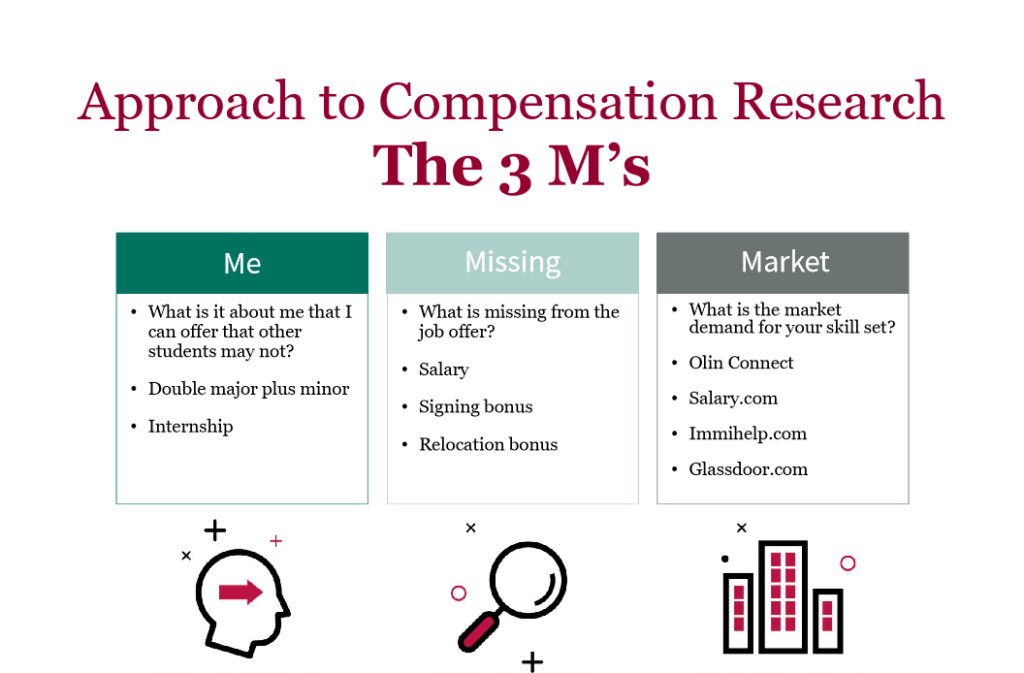
If you need to negotiate your offer, keep the 3 M’s in mind: Me, Missing, and Market. As you evaluate your offer and conduct compensation research, think about 1) what you can offer that is a uniquely advantageous “bonus” that the organization gets from hiring you instead of another student, 2) what is missing from the job offer, such as in the salary, signing bonus, or educational stipends for professional certifications, and 3) what the market looks like, in terms of the demand for your skills and the cost of living. You can use various internal and external resources, including OlinConnect and Glassdoor.com, to collect relevant data for these categories.
How to negotiate for an offer deadline extension
When you’re ready to engage in the conversation about your offer, approach it with a positive mindset! Start with gratitude for the opportunity, make your request or additional clarity, and close it with appreciation.
Below is a sample request for an offer extension. If possible, try to have this conversation over the phone vs. in an email.
Sample request for an offer extension:
“Thank you very much for the offer. I’m very excited for the opportunity and am taking the decision process very seriously. I’d like to complete my campus recruiting process to ensure I’m making the best career decision. Would it possible to extend my response date to November 15?”
Our offer guidelines are on our Career Center website and outlined below. You can also find them here: https://talent.wustl.edu/post/policies/
- Fall Recruiting Full-Time or Internship Offers: It is common for students to receive a full-time offer at the end of the internship or in early September. For all full-time offers or internship offers made in the summer or the fall, we strongly encourage giving the student a minimum of three weeks after the offer is made or until December 1, whichever is later. The intent is to allow students to participate in the majority of fall recruiting.
- For students receiving a full-time offer in December, January or February: We recommend giving the student until March 1 or a minimum of three weeks after the offer is made, whichever is later
- Exploding offers are prohibited: Such offers put enormous pressure on our students to make a decision before they have completed the interviewing process. (e.g., any offer that does not afford a candidate the appropriate time to either accept or decline and/or has special incentives attached for the purposes of inducing early acceptances).
Additional Offer Policies:
- Students are urged to immediately release offers they do not plan to accept.
- We expect employers will demonstrate flexibility in working with students to consider reasonable requests and communicate hiring timelines clearly and acknowledge if they fall outside of the Washington University in St. Louis offer policy guidelines.
- We expect students will make requests for reasonable accommodations in a timely manner, make our staff aware of any instances in which our stated offer dates cannot be met and reneging on offers is considered a breach of both our recruiting policies and the honor code, and such action receives immediate attention with the student.
You are welcome to share these guidelines with your employer. At the end of the day the employer isn’t obligated to follow our rules, but some will once they have been shown our policies.
Prior to a conversation, prepare your approach thoroughly and think through the components of the conversation, including your request, your objective, and potential responses to your requests. If you think through how the conversation will go and your decision tree thoroughly, you’ll feel more confident and composed in the real conversation. If you have thought through the employer’s potential responses, you’re less likely to be caught by surprise.
As you navigate this process, represent yourself and WashU well and recognize that having a conversation about your offer is totally normal and the offer remains after it. Again, it is normal to feel nervous in these interactions however conducting yourself professionally will lead to greater respect. If you or someone you know has questions or concerns about the process, the various timelines, an early offer, or negotiating, please encourage them to check in with a Career Coach and get support to understand the context of the recruiting landscape, evaluate options, and develop a personalized plan.
Other factors beyond compensation to negotiate:
- Work/life balance
- Personal values
- Level of responsibility, challenge and intensity
- Team versus independent work environment
- Opportunities for advancement
- Learning, helping and decision-making opportunities
- Corporate culture and diversity in the work place
- Physical environment and working conditions in the work place
- Geographic location and travel opportunities
Communicating Your Decision
Congratulations! You have just received the eagerly awaited phone call from a recruiter. In anticipation of receiving an offer, be prepared to discuss the following with the recruiter so when the offer is made, you are in command of your response.
- Thank the recruiter and express your excitement and pleasure about the offer.
- Clarify the next steps in the process: When will the paperwork be sent to you? Is there a deadline for accepting or declining the offer? Are there other requirements to fulfill?
- Ask the recruiter about the best times to contact him or her with any questions about the offer material.
- Wrap up the call by reiterating your pleasure at receiving the offer and confirming that you will review the offer materials and respond within the agreed-upon time frames.
Once you have decided to accept an offer, communicate your decision to the recruiter as soon as possible. Calling the recruiter is usually the preferred way to communicate your acceptance. Be sure to reconfirm the start date, salary and other compensation information – this allows the recruiter to move forward with the next phase in bringing you on board.
It is unprofessional to continue a job search after you have accepted a job offer. Be sure to withdraw from all other interviews immediately. You should not renege on a previously accepted offer, as this can damage your professional reputation and reflects poorly on you as an individual and on Washington University.
Accept offers in good faith. An accepted offer is binding and assumes that you are no longer job searching. Students are expected to withdraw from all applications and are not permitted to interview with additional firms after accepting an employment offer. This is standard professional expectation at all business schools. If you renege on an offer, the WCC reserves the right to take appropriate action.
Declining Other Offers
Contact other employers with whom you were still in the interview process to let them know you will not be moving forward with them. Do this as soon as possible so they can move on with other candidates. Make sure you thank them for their interest in you.
Calling the employer(s) to communicate your decision is preferred. If email has been the method of communication throughout the offer process, however, you may use email to communicate your decision.
Exploding Offers
An exploding offer is any job offer that does not afford you time to either accept or decline the position and has special incentives attached for the purpose of inducing early acceptance. Exploding offers can place a tremendous amount of pressure on you before you’ve completed the interviewing process and are strongly discouraged.
Deadlines for Offers
The Center for Career Engagement recognizes that students should have the opportunity to investigate employment options of interest when making career choices. If you need additional time to decide, you may request more time from the recruiter. It is important, however, to express your interest in the offer.